
The Skill That Actually Scales a Business (And It's Not Marketing)
Twenty years in digital marketing and automation taught me growth's real bottleneck isn't leads. It's capacity, and the engineering underneath it.
 By Anthony PhillipsPublished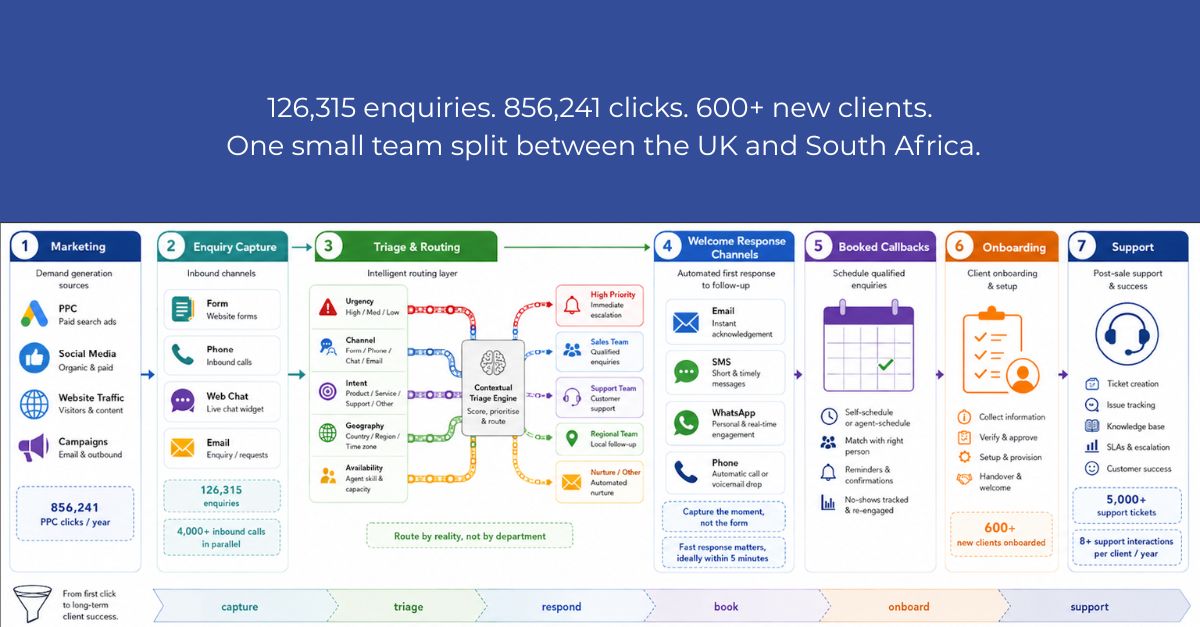
Most businesses that fail to scale don't have a demand problem. They have a capacity problem, and they've spent years mistaking it for a marketing one.
After twenty years building online businesses, digital marketing systems, automation pipelines, AI expertise and growth infrastructure across the UK and South African markets, that's the pattern I keep coming back to. Generating interest is one skill. What happens to that interest in the next five minutes, five hours, or five days is a completely different one, and it's the one most businesses, and most agencies, never properly build.
The numbers behind "scale"
Here's what that actually looks like at volume. In a single year, one business in our group, Ready Made Stores, generated:
All of it run by a small team split between the UK and South Africa.
Run the maths on that and a sharper picture appears:
- 14.75% of clicks converted into an actual enquiry, roughly 1 enquiry for every 6.8 clicks.
- 4,000+ inbound calls ran in parallel to the digital enquiry flow, around 3.2% of total enquiry volume choosing to pick up the phone instead of filling in a form.
- 5,000+ support tickets against 600+ clients works out to over 8 support interactions per client across the year, on top of everything that happened before the sale.
That last stat is the one people miss. The work doesn't stop at the close. A team handling six-figure enquiry volume is simultaneously running thousands of post-sale support interactions, on the same headcount that handled the enquiry, the call, and the conversion. None of that runs on manual process and good intentions. It only works if someone has engineered the system underneath it, and that's the part of the job I've spent two decades on, not the part that gets the case study slide.
Three rules, not a tech stack
People assume the answer is "buy more software." It isn't. Tools change every couple of years; the rules underneath them haven't, in twenty years of doing this. Every system I've built comes back to three things.
1. Capture the moment, not the form
A form submission isn't the start of the relationship, it's the tail end of a decision someone already made. By the time they hit submit, the clock is already running. Treat the form as a deadline, not a trigger.
2. Route by reality, not by department
Geography, urgency, channel, and intent should decide where an enquiry goes, not an org chart. A high-intent buyer messaging at 11pm and someone filling in a contact form on a Tuesday afternoon are not the same event, and they should never sit in the same queue.
3. Make delay visible before it becomes a complaint
The most expensive failures I've seen in twenty years weren't system failures, they were silent ones. Nobody noticed a lead had gone cold until the customer mentioned it, annoyed, three days later. If you can't see your own backlog in real time, you don't have a system. You have a guess.
The channel shift most businesses still haven't adjusted for
For years, those three rules were enough on their own, enforced through plain workflow logic, no AI required, just disciplined plumbing between ad platforms, forms, CRMs, and calendars.
Then customer behaviour moved faster than most businesses' systems did. Email response rates started sliding years before anyone declared email "dead." Attention moved to phones. The conversations that actually decided whether someone bought, pricing, availability, "can you do this by Friday", started happening in SMS threads, WhatsApp, and live chat, not inboxes. Harvard Business Review research on lead response is over a decade old and the curve has only got steeper since.
That matters more than it sounds. It's well established that contacting a lead within roughly five minutes converts dramatically better than waiting even half an hour. At a volume of 126,315 enquiries a year, a few hours of average delay isn't a missed opportunity here and there, it's a fixed percentage of every pound spent on demand generation, leaking out before anyone notices. Even a small improvement in response speed moves real revenue.
Where AI actually earns its place
This is where most people get the order wrong. AI didn't build the automation. The routing logic, the triage rules, the escalation paths, all of it existed and was already carrying real volume long before generative AI was something you could buy off the shelf.
What AI changed is what that existing infrastructure can do. Static triage rules became contextual. Templated replies became responses that read like someone actually understood the question. A small team can now protect response times at a volume that would normally demand tripling headcount, without ripping out twenty years of structure to get there. That's the philosophy behind our Risponda lead management platform and the wider Growth Engine.
AI didn't replace the expertise. It gave people who already had the expertise a sharper instrument.
The actual skill
Generating demand isn't the hard part. 126,315 enquiries from 856,241 clicks proves that piece can be solved with a media plan and a budget.
The skill that's hard to find, and the one I've spent twenty years building, is the layer underneath: automation that captures intent the second it appears, routing that reflects how customers actually behave, and a follow-up system fast enough to push a close rate meaningfully higher, without adding a single extra person to the team. If you want to see what that looks like applied to your business, get in touch.
That's automation. That's growth. That's scaling. Not as buzzwords, as the actual discipline of making a small team perform like a much larger one.
Ready to Take the Next Step?
Book a free consultation with the Ready Made Digital team and explore how we can help grow your business.
Get in TouchRelated Articles

From Missed Calls to Fully Booked: How an Aesthetics Clinic Transformed Its Lead Pipeline with Ready Made Digital
Read article
AI Marketing Tools Will Not Save a Weak Offer, a Bad Website or Lazy Follow-Up
Read article